The Huachicol Economy
Five years of fuel theft, political financing, and impunity — a connected account of the Carmona, Altamira, and Foullon chapters.
Seen separately, the Carmona murder, the Altamira tankers, and the Lady D allegations are three independent stories. Seen together, they are one continuous story in three chapters — the story of an economy that has learned, at each turn, how to survive the removal of its principal operator.
A Single System, in Three Chapters
Huachicol, in Mexican usage, covers the entire illegal ecosystem around fuel products — theft, illegal import, distribution, invoicing, and the political architecture that protects all of them. Over the past five years, that ecosystem has passed through three architectures that look, at first, like separate cases.
The first is the Reynosa customs corridor run by Julio Carmona Angulo and financed by his brother Sergio — the so-called King of Huachicol — from approximately 2018 through Sergio's murder in November 2021. The second is the Altamira sea-based operation documented by Código Magenta in March 2024, in which two tankers — Nord Supreme and Nord Harmony — unload hundreds of thousands of barrels of refined fuel weekly into an open field at the port. The third is the allegations against Diana Foullon Gómez — Lady D — that place the next chapter directly inside the Mexican National Customs Agency, where her father, Dr. André Georges Foullon Van Lissum, serves as director.
Each chapter has its own dramatic surface. The structural question — and the one most useful for a private-office reader — is what the three chapters share.
Chapter One: Reynosa, 2018–2021
Sergio Carmona Angulo was killed on November 22, 2021, in a barber shop in San Pedro Garza García, Nuevo León. The operational signature of the attack — surgical execution, crew-cut operators, public-safety cameras offline — pointed to planning well beyond a conventional cartel dispute. His brother Julio César, who had run the Reynosa customs office early in the current administration, entered the U.S. Witness Security Program in February 2022.
What made Carmona more than a smuggler was the financial architecture he built around the operation. Twelve properties in Texas and a similar number in greater Monterrey supplied the visible footprint. The invisible footprint was the political-financing channel: chartered aircraft for Morena rallies, direct financial support to multiple governorship candidates — Francisco García Cabeza de Vaca (PAN) and Américo Villarreal Anaya (Morena) in Tamaulipas among them — and shared logistical resources for Morena campaigns in Nuevo León, Baja California Sur, Sonora, Sinaloa, and Nayarit. By the reporting available in open sources, the five-year cumulative value of the operation was on the order of 400 billion Mexican pesos.
When Carmona was killed, the public assumption was that his network had been neutralized. It had not. What had been neutralized was its principal operator.
Chapter Two: Altamira, 2023–2024
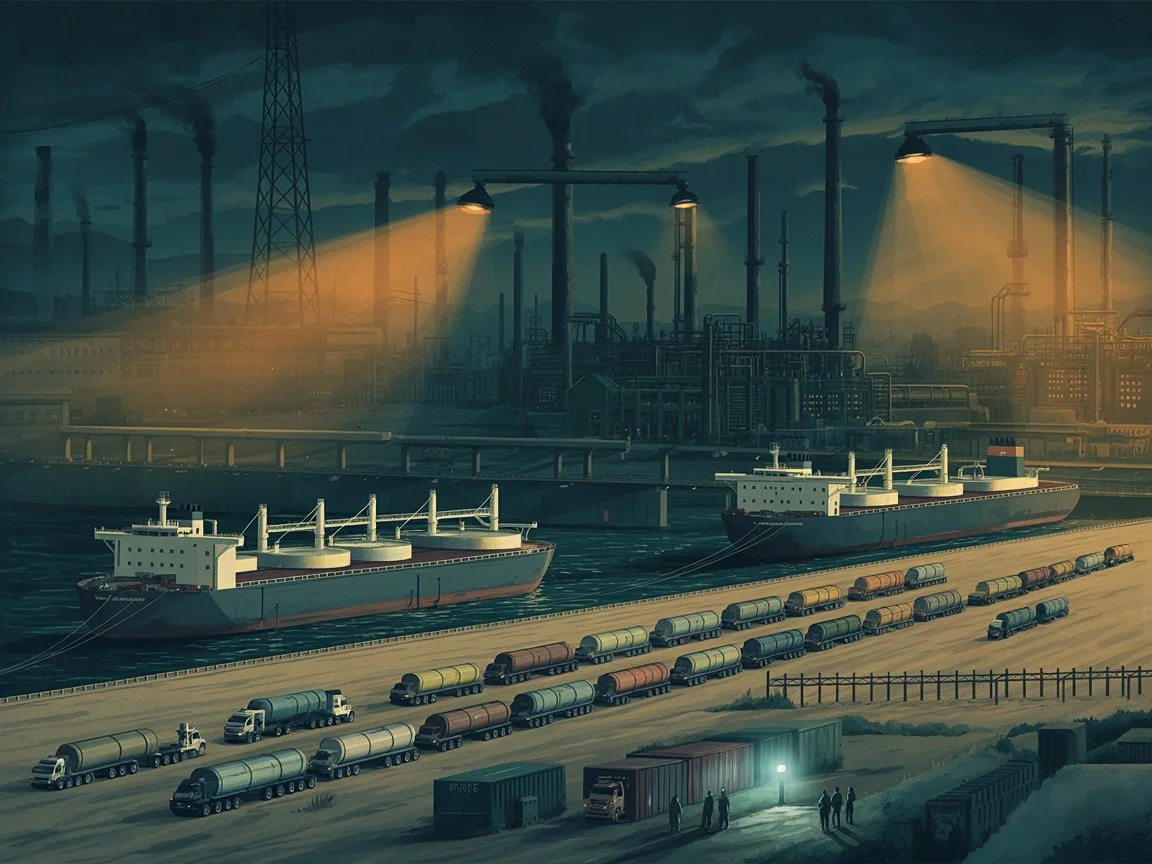
By early 2023, a different pattern had emerged at the Port of Altamira, Tamaulipas. Código Magenta's investigative broadcast of March 21, 2024 documented it in detail: two tankers arriving each week, on a regular Houston–Altamira rotation, unloading directly into waiting tanker trucks in an open field — approximately 6,600 trailers per month, roughly 220 per day including weekends, moving refined fuel without transit through the port's storage infrastructure, without observable accounting, and without compliance with international safety protocols for bulk fuel transfer.
The policy backdrop made the operation harder to explain away. In October 2023, Mexico's Energy Ministry cancelled 138,000 daily barrels of private-sector fuel imports that had been running under the prior energy-reform framework. The Energy Regulatory Commission denied operating permits to several private receiving terminals — one of them a $120 million Valero facility at Altamira itself, inactive, a few hundred yards from where Nord Supreme and Nord Harmony were unloading.
Mexican refinery output over the same period showed a nine-percent year-over-year decline in gasoline production in 2023. Deer Park — the Texas refinery now majority-owned by Pemex — posted a seven-percent production decline in the first half of 2023, with utilization falling from 85 to 75 percent. Under those conditions, the case for revoking private-sector import permits on supply-security grounds is difficult to sustain. The case for reorganizing a contraband route from land to sea, to a single point of control at a single port, is much easier to follow.
Chapter Three: ANAM, 2024
The Lady D allegations, published in November 2024, place the next iteration directly inside the Mexican National Customs Agency — one administrative level above the Reynosa office from which Carmona ran the first chapter. Diana Foullon Gómez is alleged to coordinate a fuel-theft operation through partner José Ángel Sánchez Suchil, logistics coordinator Arnold Tamé, and operators Efrén Martínez Morfín and Leticia García Valencia running gas stations in Matamoros. The operations are said to draw protective relationships at Pemex and in local and federal judicial offices.
The murder of Carlos Narváez Romero in Polanco, Mexico City — rumored in Mexican reporting to carry a message for Diana Foullon's father, General Foullon Van Lissum — preserves the operating rules of the sector. The message is public, the violence is precise, and the intended audience is not the victim.
The Shared Architecture
Three chapters, three architectures, one system. What moves across all three is not the individual operator. It is the four structural features that make the system durable.
First, the capture of a specific administrative node — a customs office, a port field, a director's office — through which the flows can be reliably managed. Second, a protective envelope that extends into the ruling political coalition, most visibly through campaign financing but also through discretionary regulatory decisions. Third, a willingness to use public, precisely targeted violence to enforce the operating rules when a principal figure is removed. Fourth, the near-complete absence of independent-verification capacity through Mexican official channels — a condition that has tightened further with the dismantling of autonomous oversight institutions through the 2024 constitutional amendments.
Those four features are why the removal of any single operator — Sergio Carmona, Julio Carmona, or future principals in the current chapter — does not close the system. The system is not a person. It is a pattern.
Why It Matters for Private Capital
For a private-office reader with Mexican exposure, the Huachicol economy is not primarily a fuel-sector story. It is a governance story whose implications run broader. The same four structural features — node capture, protective envelope, enforcement violence, and verification collapse — now also describe the broader operating environment for private capital in sectors that touch Pemex, CFE, Customs, or any regulator reconstituted under direct executive control.
That reality does not preclude private activity in Mexico. It does change the discipline required. The practical implication for private operators is that counterparty diligence cannot lean on Mexican regulatory or disclosure channels alone; that reputational risk of adjacent counterparties is higher than the underlying transaction risk would suggest; and that contract histories — dates, signatories, amounts, changes — need to be built from original documents rather than inferred from public summaries.
The three chapters are not finished. A fourth will follow. The signal to track is not the next principal operator — it is the next architectural node that the system has captured..
The Takeaways
The Reynosa, Altamira, and ANAM chapters are one continuous system; treating any of them as isolated cases will under-price the risk of the next iteration.
The four structural features — node capture, protective envelope, public enforcement violence, and verification collapse — are the correct lens for reading Mexican counterparty risk in any regulated sector, not only fuel.
The dismantling of autonomous oversight institutions through the 2024 constitutional amendments removes independent-verification channels that private capital has historically relied on; the private side now carries more of the verification burden.
Contract-history work — dates, signatories, amounts, and subsequent modifications — remains the single most useful discipline for a private-office client with Mexican exposure, because it produces evidence that survives the reorganization of the system around any one operator.
The Intelligence Research Desk at GO PRIVATELY LLC
All information sourced from publicly available intelligence. Conditions evolve; verify current status before operational decisions.