Houston to Tampico
What the Ikon Midstream raid says about the fiscal huachicol economy and the firms drawn into it.
On a Thursday in mid-April, U.S. Customs and Border Protection officers walked into a Houston office tower and left with computers and servers. Five days later, a Mexican rear admiral was arrested in Buenos Aires using a forged Guatemalan passport. The two events are part of the same story.
What happened, in plain language
U.S. federal agents executed a search warrant at the Houston headquarters of Ikon Midstream LLC, a fuel-trading firm with offices on San Felipe near the Galleria. The action was first reported by Reuters on 16 April 2026 and confirmed by the company's own attorney. Computers and servers were seized. No arrests were made. No charges have been filed. The company denies wrongdoing and is suing Reuters for defamation over the original investigative report that put it on regulators' radar.
Six days later, on 22 April, Mexico's Fiscalía General de la República announced the dismantling of what it called one of the most significant fuel-smuggling networks in the country's recent history — fourteen arrests, twenty-three billion pesos in simulated commercial operations, and a logistics chain that moved cargo by ship, by rail, and by truck across at least three states. The next day, a former Mexican Navy rear admiral wanted in connection with the same network was arrested by Argentine federal police in the Palermo neighborhood of Buenos Aires.
These are not three separate stories. They are three visible pieces of a single multi-year scheme, carefully built and now coming apart in public.
The mechanism, simply
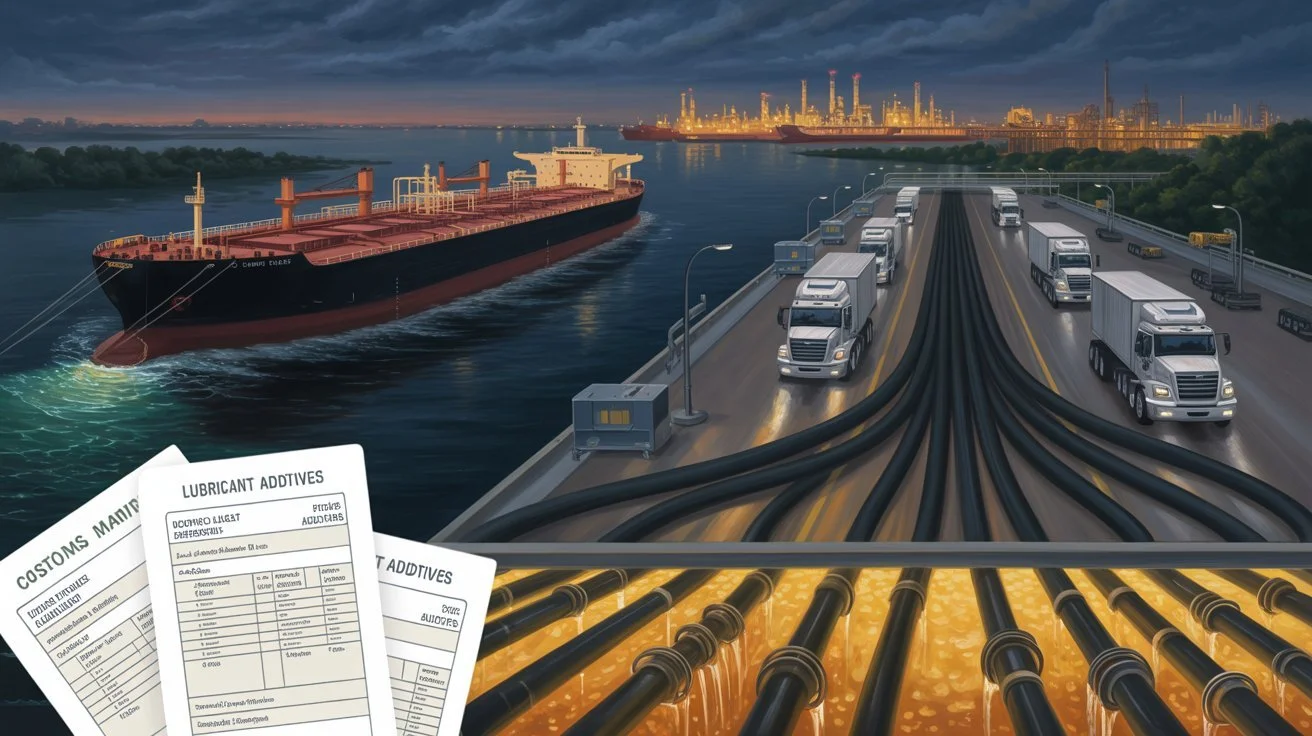
The scheme is called fiscal huachicol — paper huachicol — to distinguish it from the older practice of physically tapping Pemex pipelines. The mechanism is simpler than the name suggests. Diesel and gasoline are bought legally at U.S. and Canadian terminals, loaded onto tankers, and shipped to Mexican ports. The fuel is real. The paperwork is fictional. At the Mexican border, the cargo is declared not as diesel or gasoline but as lubricating oil additives — a category that carries little or no IEPS, the Mexican excise tax that represents roughly forty to fifty percent of the retail price of fuel. Once inside Mexico the product is rebranded, redistributed, and sold at full market price. The margin is the entire tax.
Reuters reported in October 2025 that a single shipment loaded onto the tanker Torm Agnes from Imperial Oil's Vancouver terminal — roughly 120,000 barrels of diesel — was declared at U.S. and Mexican ports as lubricants, listed at one-tenth its market value, and would have evaded approximately seven million U.S. dollars in Mexican import taxes if completed as documented. That single voyage is the example. The pattern is much larger.
Mexican tax authority records published in January 2026 show that the Challenge Procyon — a tanker seized in March 2025 at the Port of Tampico — actually carried 20.9 million liters of diesel, double the ten million liters the Mexican government announced at the time. The accounting gap of roughly ten million liters has not been publicly resolved.
What the official numbers say
Mexico's tax authority and prosecutorial figures, taken together, describe a market disruption rather than a series of incidents. SHCP, the Mexican treasury, reports 109 active criminal files for fiscal huachicol totaling twenty-three billion pesos. ANAM, the customs agency, reported in October 2025 that thirty customs agents controlled the network at its peak — all since removed — and that more than 800 investigations are active, with 326 individuals bound over to prosecution and 78 already sentenced. El País, citing tax data published in January 2026, documents a structural anomaly: lubricant imports into Mexico rose from 8.8 billion liters in 2019–2020 to 32.9 billion liters in 2021–2022, an increase of nearly 27 billion liters that cannot be explained by industrial demand.
Estimates of annual losses to the Mexican treasury vary widely depending on methodology. The most disciplined figures, from El País and Reuters source analysis, sit between four and nine billion U.S. dollars per year. Other estimates run higher. Official figures from the FGR, narrowed to the single network it dismantled in April, are lower. The honest read is that the scale of fiscal huachicol is large enough that the precise number does not change the conclusion: this is not a series of bad actors. It is a parallel fuel economy.
Where Ikon Midstream sits in this
Reuters' October 2025 investigation traced 149 shipments declared as lubricants by Ikon Midstream to Mexican customs between October 2019 and May 2025. Sixty-seven of those moved by ship. The company describes itself as a fuel trader and blender serving the Mexican market and built a fuel terminal in Laredo to do so. Its CEO, Rhett Kenagy, has stated through counsel that the company conducted its business lawfully and has not falsified U.S. or Mexican documents.
What Ikon Midstream represents — regardless of how this particular case resolves — is the U.S. side of the architecture. Fiscal huachicol cannot exist with only Mexican participation. Real fuel has to be bought, loaded, shipped, and invoiced from somewhere. That somewhere is Texas refineries, Canadian terminals, U.S. and Canadian shipping companies. The architecture sits squarely on the Houston-to-Mexican-port corridor that Texas energy companies have built honestly over decades, and which a small number of operators allegedly weaponized.
It is worth saying clearly what is and is not on the record. The Houston raid is confirmed. Computers and servers were seized. No charges have been filed against Ikon Midstream or its principals. The defamation suit against Reuters is active. Reporting from Mexican investigative outlets — particularly Código Magenta — has connected the seized data to a much wider political story involving members of the family of former president Andrés Manuel López Obrador. Those connections, at the time of writing, rest on a single source. They have not been corroborated by U.S. official statements, by Reuters, or by the FGR. We treat them here as serious allegations under investigation, not as established fact.
Why this matters for executives and family offices in Mexico
The investigation is widening, not narrowing. The relevant question for principals with operations or counterparties in Mexico is not whether fiscal huachicol exists. It does. The question is whether any vendor, partner, customs broker, or carrier in their existing structure was active in the affected ports during the affected years. The list of ports already named is not short — Tampico, Altamira, Ensenada, Guaymas, Tuxpan, Manzanillo, Veracruz, Dos Bocas. The window already named is not narrow — 2020 through early 2026.
The exposure is not only criminal. Mexico's reformed Customs Law, in force since 1 January 2026, makes customs agents jointly liable for misclassified merchandise. The new CFDI fuel-invoicing requirement, in force since 24 April 2026, links every fuel invoice to a valid CNE permit on a digital trail. The U.S. Treasury's FinCEN issued a formal alert in May 2025 listing fourteen red flags for financial institutions handling oil-related flows from Mexico, and reported more than 827 million U.S. dollars in suspicious transactions in the four months following the alert. OFAC has sanctioned three separate networks since September 2024. The compliance terrain is shifting underneath any business that touches this corridor.
For a family office, the practical implications are quiet and specific. Re-examine fuel-related counterparties active in Mexican ports during 2020 to 2025. Confirm beneficial ownership on Mexican counterparties registered at residential or non-operational addresses. Refresh KYC on transport and storage providers who serviced the named ports. Review whether any fuel invoice held by an operating company links cleanly to a valid permit under the new CFDI rules. None of this is reactive. It is the housekeeping of a credible operating posture in a market that has just had a discontinuity.
What we are watching next
Three signals will tell us where the case is going. The first is whether U.S. prosecutors file charges, and against whom. A search warrant produces evidence; what comes of that evidence is the meaningful question. The second is whether the FGR's investigation moves from line operators — captains, transporters, customs agents — into the political class. The official posture has been that the institutions did not know. The audio recordings published by Aristegui Noticias in February make that posture harder to hold. The third is whether the Mexican Congress and the Sheinbaum administration return civilian oversight to the customs and port functions transferred to the Navy under the previous administration. That is the structural question. Without it, the next iteration of the same scheme is being built right now.
We will return to all three in subsequent pieces.
The Takeaways
Fiscal huachicol is not pipeline theft. It is industrial-scale customs fraud — diesel and gasoline imported into Mexico declared as lubricant additives to evade IEPS. Annual losses to the Mexican treasury are estimated between four and nine billion U.S. dollars.
The Houston raid on Ikon Midstream is the U.S. side of an investigation that has been moving in Mexico for more than two years. No charges have been filed in the United States and the company denies wrongdoing.
The exposure for legitimate operators is not only criminal. Mexico's reformed Customs Law, the new CFDI fuel-invoicing rules, FinCEN's formal alert, and active OFAC sanctions are reshaping the compliance terrain underneath any business in this corridor.
For family offices with Mexican operations, the practical work is housekeeping: re-examine fuel-related counterparties active in named ports during 2020–2025, confirm beneficial ownership where addresses are residential, refresh KYC on transport and storage providers, link every fuel invoice to a valid permit.
The investigation is widening, not narrowing. Three signals matter next: U.S. charging decisions, whether the FGR moves into the political class, and whether civilian oversight is returned to customs and port functions.
The Intelligence Research Desk at GO PRIVATELY LLC
Source context: this analysis draws on Reuters investigative reporting (16 October 2025; 16 April 2026); El País Mexico (October 2025; January 2026; April 2026); Aristegui Noticias and MCCI (January 2026); Bloomberg Law (November 2025); the FGR press conference of 22 April 2026; the U.S. Treasury OFAC sanctions actions of September 2024, May 2025, and December 2025; the FinCEN Alert on Oil Smuggling Schemes (May 2025); SAT and ANAM administrative records; the U.S. Department of Justice Wilson and Rovirosa Pemex bribery cases; and the Argentine Federal Police statement of 23 April 2026. Allegations involving political figures rest on Mexican investigative outlets and have not been independently corroborated by U.S. official sources at the time of publication.