Huachicol by Sea
Weekly tanker arrivals at the Port of Altamira suggest the Reynosa contraband route has moved offshore.
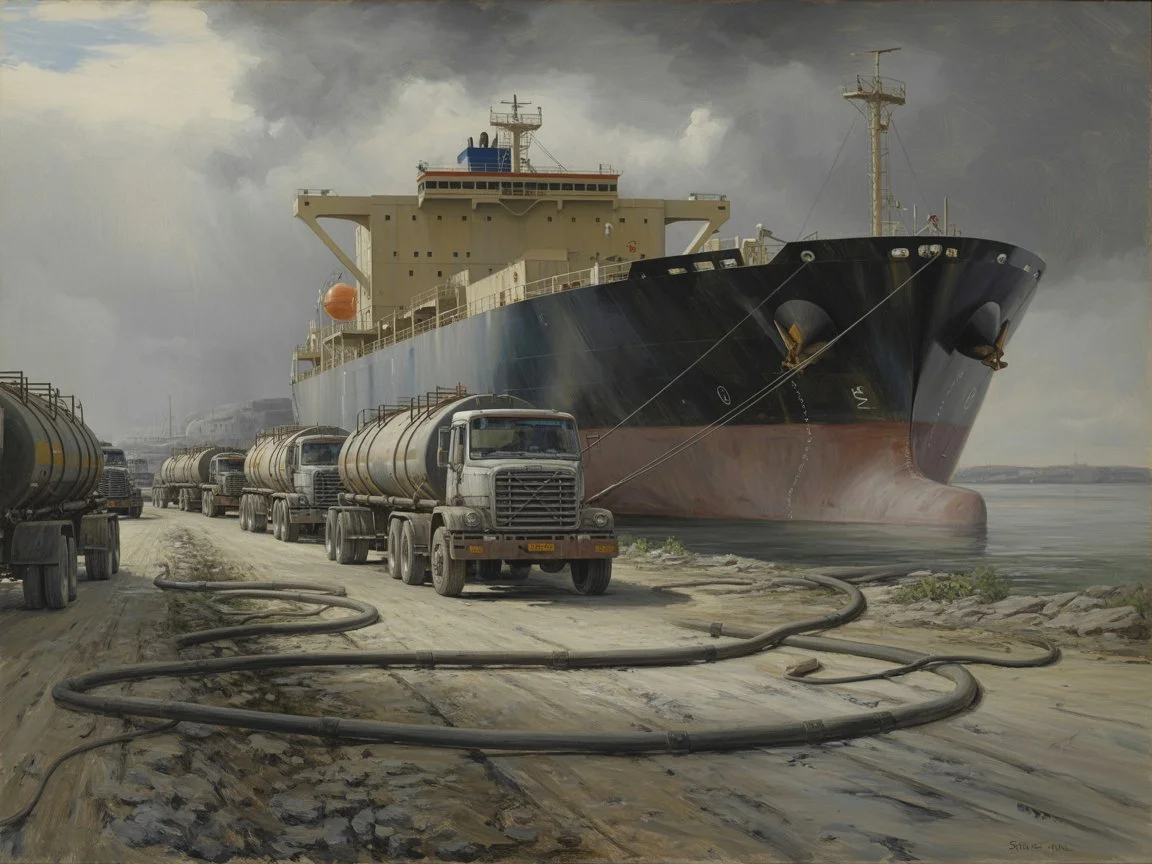
An investigative broadcast by Código Magenta on March 21, 2024, documented an extraordinary pattern at the Port of Altamira, Tamaulipas: two tankers arriving each week, unloading hundreds of thousands of barrels of refined fuel directly to waiting trailer tanks, in an open field, without storage infrastructure or apparent accounting.
Source and Scope
This note is analytical commentary on a Código Magenta investigative broadcast first aired on YouTube and related platforms on March 21, 2024, and is intended to preserve the reporting for readers tracking the trajectory of the fiscal Huachicol system. The full investigative video remains available on Código Magenta's public channels.
The Operation at Altamira
For roughly a year prior to the March 2024 broadcast, two tankers arrived at the Port of Altamira on a weekly basis. Code Magenta identified the vessels as Nord Supreme (Danish flag) and Nord Harmony (Panamanian flag), and reported that both run a route between Houston and Altamira up to four times per week. The two vessels together carry roughly 2.4 million barrels of refined product over a thirty-day window — approximately 380 million barrels annually at that cadence.
What distinguishes the operation is not the volume. It is the method. The broadcast documented that cargo was being transferred directly from the vessels to waiting tanker trucks — by the reporting, approximately 6,600 trailers per month, or roughly 220 per day including weekends — using narrow hoses into an open field, without transit through the port's storage infrastructure, without observable accounting controls, and without compliance with the basic international safety protocols that govern bulk fuel transfer.
The Reynosa Context
The timing of the Altamira pattern aligns with the decline of the long-running Reynosa customs contraband corridor. That corridor was managed through the Reynosa Customs office early in the current administration by Julio Carmona Angulo, who entered the U.S. Witness Security Program in November 2021 after his brother Sergio — the self-styled King of Huachicol — was murdered in San Pedro Garza García in Nuevo León that same month.
The inference drawn by Código Magenta is straightforward: the route moved from land to sea. One consolidated unloading point at a single port — Altamira — has a lower operational signature than a dispersed network of trailer crossings at the U.S. border, and it is materially easier to manage from a single-point-of-control perspective.
The Regulatory Backdrop
In October 2023, Mexico's Energy Ministry cancelled the importation of 138,000 daily barrels that private operators had been processing under the prior energy-reform framework. A parallel wave of Energy Regulatory Commission (CRE) decisions denied operating permits to several private fuel-receiving terminals. One such facility sits at the Port of Altamira itself: a Valero terminal, built at a cost of roughly $120 million, designed to add 1.1 million barrels of import capacity, and currently inactive. Nord Supreme and Nord Harmony unload a few hundred yards away.
The macroeconomic picture amplifies the question. Mexican refineries produced approximately 229,000 daily barrels of gasoline when the current administration took office; by 2024, that figure stood at 242,000 — a marginal gain despite billions in capital investment. Mexican gasoline production in 2023 dropped nine percent year-over-year. Deer Park, the Texas refinery now majority-owned by Pemex, posted a seven-percent first-half production decline in 2023 relative to 2022, with utilization falling from 85 to 75 percent. Against that backdrop, the revocation of private-sector import permits is more difficult to explain through a production-security rationale alone.
The Political-Financing Question
Código Magenta explicitly connects the Altamira activity to the same political-financing system that Sergio Carmona Angulo operated at the border. That system, at its height, was estimated to have moved roughly 400 billion Mexican pesos over five years, with a significant portion directed to the national ruling party and to Morena gubernatorial campaigns in Sinaloa in 2021 and Tamaulipas in 2022.
Whether the Altamira flows are connected to the same channel is the open question. What is documented is a multi-hundred-million-liter weekly unloading pattern in an open port field, in the same state where the Carmona network financed the 2022 gubernatorial campaign.
The Takeaways
The Reynosa corridor did not close after the Carmona murder; the evidence suggests it reorganized. A single-port, sea-based architecture is consistent with the reporting.
The simultaneous revocation of private-sector import permits and the expansion of unaccounted vessel unloading at a port with an inactive private terminal is an uncomfortable coincidence that merits continued tracking.
For private operators with Mexican fuel-sector exposure, the operating margin for open-market activity under current rules continues to narrow, and the reputational risk of adjacent counterparties continues to rise.
Any independent verification of volumes, counterparties, or invoicing along this route is unlikely to be possible through official Mexican channels in the current administration; the Código Magenta archive and comparable private reporting remain the better reference.
The Intelligence Research Desk at GO PRIVATELY LLC
All information sourced from publicly available intelligence. Conditions evolve; verify current status before operational decisions.